| Prev |
heroicrelics.org U.S. Space & Rocket Center Site Index Gemini Fuel Cell (Space Hall) Gallery |
Next |


dsc03459.jpg
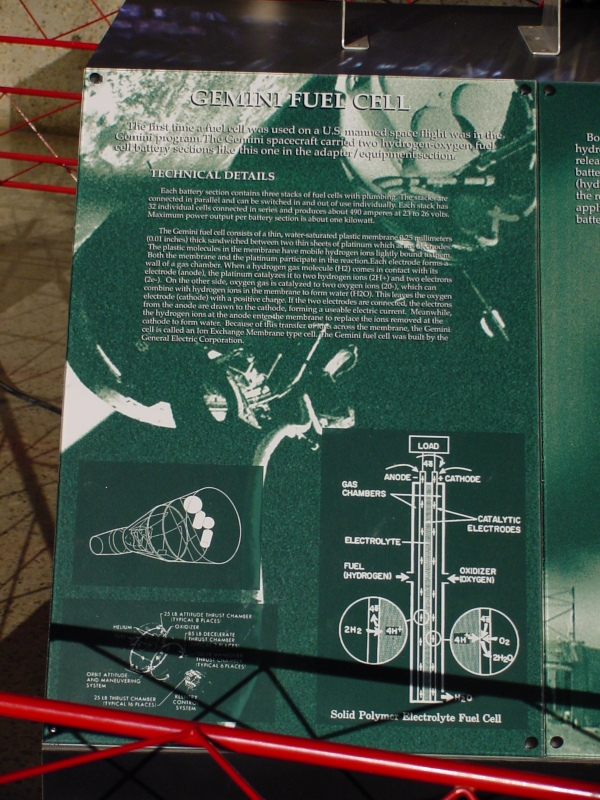
One of the signs which accompanied the fuel cell.
It read
Gemini Fuel Cell
The first time a fuel cell was used on a U.S. manned space flight was in the Gemini program. The Gemini spacecraft carried two hydrogen-oxygen fuel cell battery sections like this one adapter/equipment section.
Technical Details
Each battery section contains three stacks of fuel cells with plumbing. The stacks are connected in parallel and can be switched in and out of use individually. Each stack has 32 individual cells connected in series and produces about 490 amperes at 23 to 26 volts. Maximum power output per battery section is about kilowatt.
The Gemini fuel cell consists of a thin, water-saturated plastic membrane 0.25 millimeters (0.01 inches) thick sandwiched between two thin sheets of platinum which act as electrodes. The plastic molecules in the membrane have mobile hydrogen ions lightly bound to them. Both the membrane and the platinum participate in the reaction. Each electrode forms a wall of a gas chamber. When a hydrogen gas molecule (H2) comes in contact with its electrode (anode), the platinum catalyzes it to two hydrogen ions (2H+) and two electrons (2e-). On the other side, oxygen gas is catalyzed to two oxygen ions (2O-), which can combine with the hydrogen ions in the membrane to form water (H2O). This leaves the oxygen electrode (cathode) with a positive charge. If the two electrodes are connected, the electrons from the anode are drawn to the cathode, forming a usable electric current. Meanwhile, the hydrogen ions at the anode enter the membrane to replace the ions removed at the cathode to form water. Because of this transfer of ions across the membrane, the Gemini cell is called an Ion Exchange Membrane type cell. The Gemini fuel cell is built by the General Electric Corporation.

| Time picture taken | Fri Jun 20 14:47:09 2003 |
| Location picture taken |
Space Hall "Old" Museum U.S. Space & Rocket Center Huntsville, AL |
| Prev |
heroicrelics.org U.S. Space & Rocket Center Site Index Gemini Fuel Cell (Space Hall) Gallery |
Next |