| Prev |
heroicrelics.org U.S. Space & Rocket Center Site Index Apollo Fuel Cell Gallery |
Next |


dsce1290.jpg
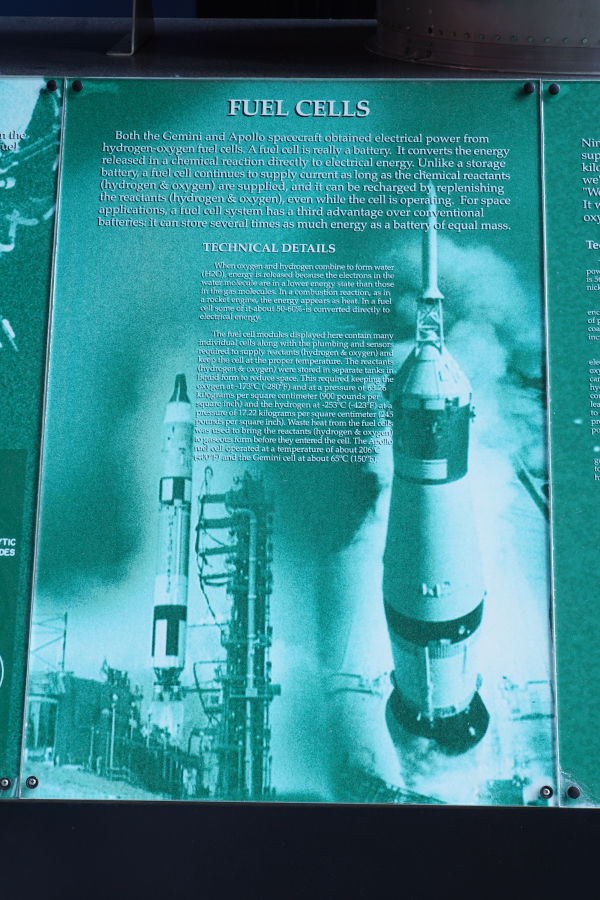
One of the signs which accompany the fuel cell.
It reads
Fuel Cells
Both the Gemini and Apollo spacecraft obtained electrical power from hydrogen-oxygen fuel cells. A fuel cell is really a battery. It converts the energy released in a chemical reaction directly into electrical energy. Unlike a storage battery, a fuel cell continues to supply current as long as the chemical reactants (hydrogen & oxygen) are supplied, and it can be recharged by replenishing the reactants (hydrogen & oxygen), even while the cell is operating. For space applications, a fuel cell system has a third advantage over conventional batteries: it can store several times as much energy as a battery of equal mass.
Technical Details
When oxygen and hydrogen combine to form water (H2O), energy is released because the electrons in the water molecule are in a lower energy state than those in the gas molecules. In a combustion reaction, as in a rocket engine, the energy appears as heat. In a fuel cell some of it - about 50-60% - is converted directly into electrical energy.
The fuel cell modules displayed here contain many individual cells along with the plumbing and sensors required to supply reactants (hydrogen & oxygen) and keep the cell at the proper temperature. The reactants (hydrogen & oxygen) were stored in separate tanks in liquid form to reduce space. This required keeping the oxygen at -173°C (-280°F) and at a pressure of 63.26 kilograms per square centimeter (900 pounds per square inch) and the hydrogen at -253°C (-423°F) at a pressure of 17.22 kilograms per square centimeter (245 pounds per square inch). Waste heat from the fuel cells was used to bring the reactants (hydrogen & oxygen) to gaseous form before they entered the cell. The Apollo fuel cell operated at a temperature of about 206°C (400°F) and the Gemini cell at about 65°C (150°F).
It's odd that gas pressures were cited as "kilograms per square centimeter," as the more customary metric measure of gas pressure is the Pascal (or kilopascals, megapascals, or bars used for higher pressure).
So, the 900 psi of the oxygen supply would be about 62 bar or a bit over 6.2 megapascals.
The 245 psi of the hydrogen supply would be about 16.89 bar or just under 1.69 megapascals.
| Time picture taken | Sat Apr 13 11:01:04 2024 |
| Location picture taken |
Saturn V Hall Davidson Center for Space Exploration U.S. Space & Rocket Center Huntsville, AL |
| Picture also in | Gemini Fuel Cell |
| Prev |
heroicrelics.org U.S. Space & Rocket Center Site Index Apollo Fuel Cell Gallery |
Next |