| Prev |
heroicrelics.org National Air and Space Museum Site Index APS Engine Gallery |
Next |

dsc33027.jpg
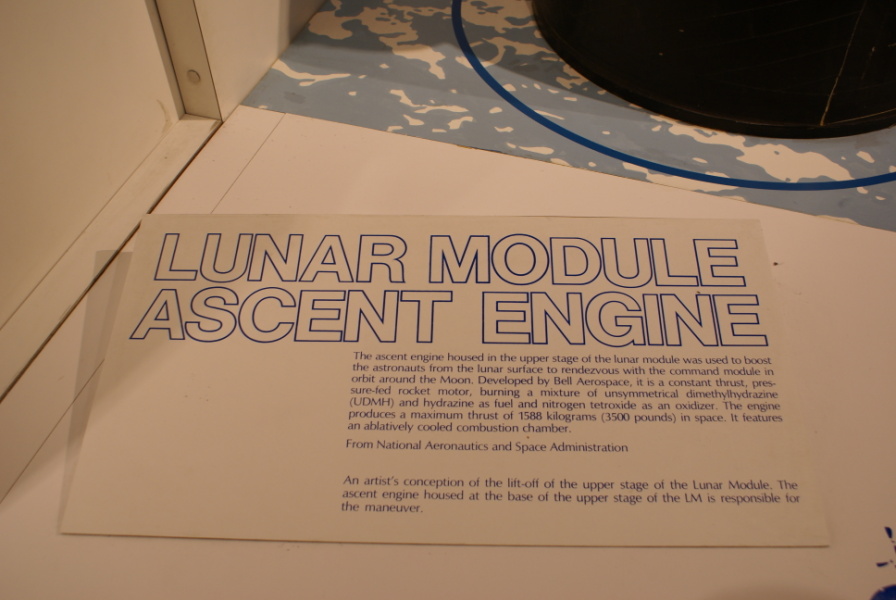
The sign which accompanied the Ascent Propulsion System engine.
It read
Lunar Module Ascent Engine
The ascent engine housed in the upper stage of the Lunar Module was used to boost the astronauts from the lunar surface to rendezvous with the Command Module in orbit around the Moon. Developed by Bell Aerospace, it is a constant thrust, pressure-fed rocket motor, burning a mixture of unsymetrical dimethylhydrazine (UDMH) and hydrazine as fuel and nitrogen tetroxide as an oxidizer. The engine produces a maximum thrust of 1588 kilograms (3500 pounds) in space. It features an ablatively cooled combustion chamber.
From National Aeronautics and Space Administration

It's odd that the thrust is rated at "1588 kilograms"; the metric measure of thrust is the newton (or perhaps kilonewtons or meganewtons for larger engines).
I suspect that the person writing this sign didn't understand that the "pounds" for which rocket engines are rated are actually "pounds-force" and so just did a conversion of pounds-mass to kilograms, rather than doing the proper conversion of pounds-force to newtons.
So, a 3,500 lbf thrust expressed in the metric system would be about 15,569 newtons (or just shy of 15.6 kilonewtons).
| Time picture taken | Fri Jun 22 13:36:02 2007 |
| Location picture taken |
Rocketry and Space Flight Gallery (subsequently closed) National Air and Space Museum Washington, DC |
| Prev |
heroicrelics.org National Air and Space Museum Site Index APS Engine Gallery |
Next |